Long drives are part of student life. Breaks, internships, moves and the trip home all tend to involve a car packed to the roofline and a route that passes through places you do not know well. Houston is one of those places for an enormous number of people, because Interstate 10 and Interstate 45 both run through it alongside a port economy that keeps heavy trucks on the road at every hour. Driving near those trucks is a different skill from driving near cars, and most of us were never taught it.
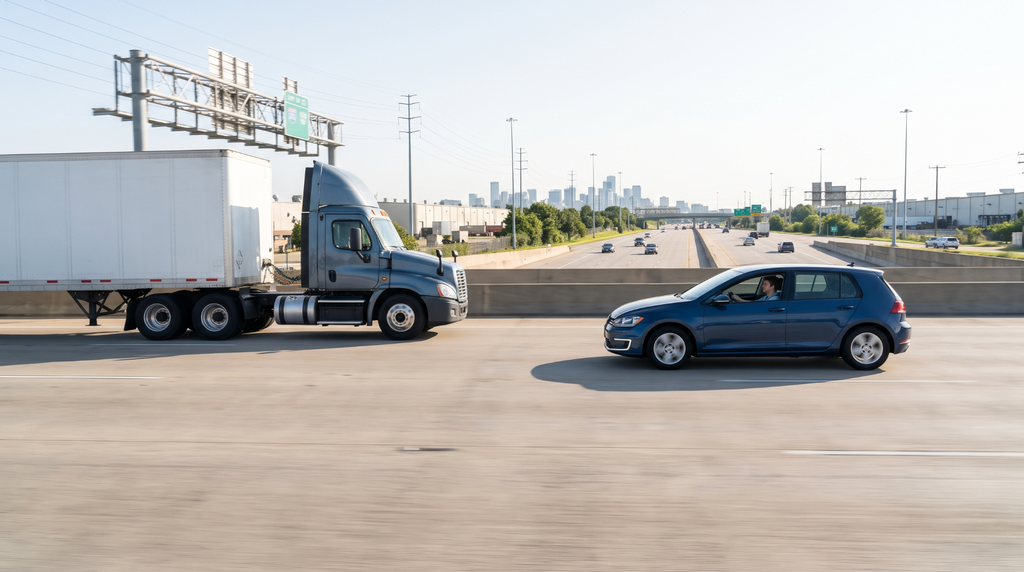
A Loaded Truck Does Not Behave Like the Car You Learned In
Stopping distance is the main difference
A fully loaded tractor-trailer can weigh around twenty times what your car weighs. Everything that follows comes from that. It needs substantially more distance to stop, and the gap grows on wet pavement and on a downgrade. The merge that feels comfortable in front of a sedan removes the cushion a truck driver has been deliberately maintaining.
The blind spots are enormous
There are four of them. Directly in front of the cab, directly behind the trailer, along the left side below the mirror, and a much larger wedge down the right side extending back and outward across more than one lane. The right side is the dangerous one, because it is the biggest and because drivers instinctively pass on the right in congestion.
Wide right turns look like an invitation
A truck swinging left to set up a right turn is not making room for you. Moving into that gap puts your car between the trailer and the curb.
The Rules Governing the Driver Next to You
Federal hours of service limits are stricter than most motorists realize. Under Section 395.3, a property-carrying driver may not drive without first taking ten consecutive hours off duty, may not drive after a period of fourteen consecutive hours following that time off, and may drive a maximum of eleven hours within that window. Driving is not permitted once eight hours of driving time have passed without at least a consecutive thirty-minute interruption. Weekly limits cap a driver at sixty hours in seven consecutive days, or seventy hours in eight, depending on the carrier’s schedule.
Why the fourteen-hour clock affects you
That window runs on wall time, not driving time. Loading delays, traffic and waiting at a dock all consume it without covering any distance. A driver late in the window has a financial reason to keep moving and a legal deadline that stops them cold. You cannot see where in that cycle the truck beside you sits, which is a reason to give it room rather than to assume competence or fatigue.
According to personal injury lawyer Lance C. Rudzinski, Shareholder and Managing Partner of Personal Injury Litigation at RTRLAW, the hours of service record is frequently the first document worth examining in a serious truck collision, because it speaks to the driver’s condition in a way no witness statement can. Collisions on the Houston freeway system often reach a Houston injury lawyer while those electronic records are still within the retention period the carrier is required to observe.
What Houston Adds to the Problem
The freeway geometry does most of the damage. Interchanges between I-10, I-45, the 610 Loop and Beltway 8 combine short merge lanes with lane drops and heavy truck volumes moving to and from the port and the industrial corridor. Exits appear on the left in places where drivers expect them on the right. An unfamiliar driver making a late lane change across several lanes is doing it surrounded by vehicles that cannot react quickly. Construction zones shift the pattern again, often narrowing lanes at precisely the points where traffic is already weaving between interchanges.
If a Collision Happens Anyway
Texas apportions fault by percentage
Under Chapter 33 of the Civil Practice and Remedies Code, a claimant may not recover damages if their percentage of responsibility is greater than fifty percent. Below that line, the award is reduced by the assigned share. In a truck case the carrier’s representatives frequently reach the scene within hours and begin building the record that supports their percentage, which is a resource an individual driver simply does not have on the day.
Capture what identifies the company
Photograph the door of the tractor for the carrier name and the US DOT number, the unit numbers on both tractor and trailer, and the license plates. Those details determine who holds the driver’s logs and the maintenance records. Note whether the truck was towed and ask the responding officer for the crash report number.
Habits That Reduce the Risk on a Long Drive
Pass on the left and finish the pass. Do not linger alongside a trailer. If you cannot see the driver’s face in their mirror, assume they cannot see you. Leave more following distance behind a truck than feels necessary, since you cannot see through it to the slowdown ahead. Plan fuel and rest stops before you are tired, because your own fatigue is the one variable in all of this that you actually control. On a drive long enough to cross several states, that single habit does more for your safety than any amount of knowledge about somebody else’s logbook.